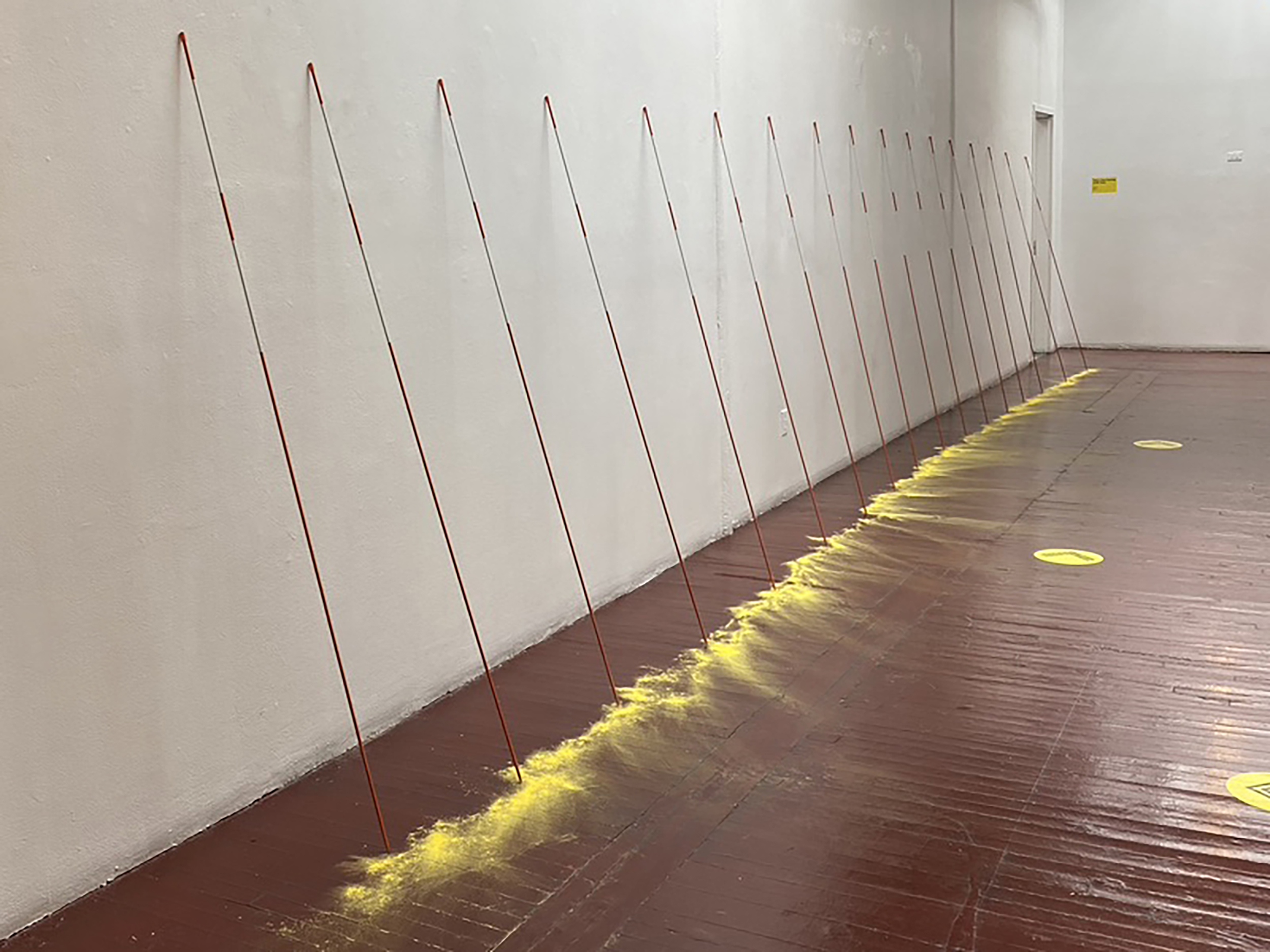
 A Walk with Traffic Stick, 2021, diemension variable
color blaze, mixed media


 A Walk with Traffic Stick, 2021, dimension variable
traffic stick, yellow powder
Traffic stick is a found object used in the urban environment to mark and signify the boundary of where to go and where not to go. Yellow powder is where I was thinking of it as the trace left by the walking/wandering experience of the traffic stick. The trace is non-linear which is very different from the yellow straight line we might see in interior space. The installation is site-specific and improvisational, it is a walking experience, a meandering trail and perhaps a piece of music.
“To make the work, Tielin instructed Ely Center to purchase commercially available sticks, typically used to demarcate construction zones and direct traffic flow in urban environments, and yellow powder. He traveled to the gallery and responded directly to its architecture using the materials. Tielin walked along a long wall and left a winding trail of powder that traced his path. Then he used the sticks to inscribe irregular, drawing-like lines in the powder and left them leaning against the wall at regular intervals, where they stand as evidence of his performative action and seemingly invite the possibility of future activation.The whole thing is succinct, provisional, open-ended, and formally appealing.
I often say that the job of the artist today is not to come up with the next new thing, but rather to look back to art history and find small gaps to fill in or ideas to expand upon. Tielin’s work makes me think of some of my favorite performative works from the 1960s and ’70s, by artists like Joan Jonas and Richard Serra, who used readily available materials to make ephemeral action traces in galleries, on city streets, or in abandoned lots. Tielin seems keenly aware of this legacy and finds room to play within it, infusing his own sense of absurdism as well as distinct formal choices, most notably his signature color, bright yellow. He also makes me think of the great Romanian conceptualist André Cadere, who was best known for his Barres de bois (Bars of wood) (1970–78), the striped wooden sticks he would carry around Paris in durational performances and occasionally install—without permission—in gallery exhibitions.”
—-Jared Quinton, Emily Hall Tremaine Associate Curator of Contemporary Art Wadsworth Atheneum Museum
“在创作这件作品时,铁林指导 Ely 中心采购了市面上常见的标杆(通常用于城市环境中划定施工区域或引导交通流)以及黄色粉末。他亲临画廊,利用这些材料直接与空间建筑进行互动。铁林沿着一面长墙行走,留下一道蜿蜒的粉末轨迹,记录下他的行进路线。随后,他用标杆在粉末上划出不规则的、类似素描笔触的线条,并将标杆以等距间隔斜靠在墙上;这些标杆既是他行为过程的见证,似乎也预示着未来再次激活作品的可能性。整件作品简洁明快、具有临时性与开放性,且在形式上极具吸引力。
我常说,当今艺术家的使命并非创造某种全新的事物,而是回望艺术史,寻找可以填补的细微空白或值得拓展的既有理念。铁林的作品让我联想到 20 世纪 60 和 70 年代我所钟爱的一些行为艺术作品——例如 Joan Jonas 和 Richard Serra 的创作,他们利用唾手可得的材料,在画廊、街头或废弃空地上留下了短暂的行为痕迹。铁林似乎敏锐地意识到了这一艺术传统,并在此框架内找到了发挥空间,融入了独特的荒诞感与形式选择,其中最显著的便是他的标志性色彩——明亮的黄色。他的作品也让我联想到伟大的罗马尼亚观念艺术家 André Cadere;Cadere 最著名的作品是《木棒》(Barres de bois,1970–78 年)系列——那是一组条纹装饰的木棒,他常带着它们在巴黎进行持续性的行为表演,并偶尔在未经许可的情况下将其置入画廊展览之中。”
—-Jared Quinton,The Wadsworth Atheneum Museum当代艺术副策展人